
As financial platforms evolve, new product capabilities often depend on information that is already being collected elsewhere in the system. Financial reporting, cash flow forecasting,…
SOFTWARE ENGINEERING & SYSTEM ARCHITECTURE | 91
Financial software needs to connect data, transactions, external systems and operational processes reliably.
Banking, payments, accounting platforms and financial APIs each form part of a wider operation.
| 91 designs and develops FinTech software systems that bring these components together and automate financial workflows where it makes sense.
Financial products rarely operate within a single system.
Transactions originate in one place and need to be processed somewhere else. Banking data needs to move between platforms. Payments need to be connected with accounting records. Financial information needs to be reconciled and made available to the people and processes that depend on it.
As the product or operation develops, those connections become increasingly important.
We design software around that wider financial system.
We design and develop software where financial functionality is central to the product or operation.
We build functionality around banking data, payment collection and initiation, recurring payments and associated financial processes.
We connect banking services, payment providers, accounting platforms, APIs and other external financial systems.
We structure and connect financial data so transactions and information can move consistently through workflows, reconciliation and reporting.
Processes that depend on moving, matching or processing financial information can be automated where the underlying rules and data allow it.
We build the applications and workflows through which users manage financial processes and interact with the wider system.ik moet even facncy boxes maken hiervan graag kleur en icoon
A payment, bank transaction or accounting entry rarely exists in isolation.
Information needs to move between systems while remaining consistent throughout the process.
That makes the structure of the data and the connections between systems fundamental to how financial software operates.
Rather than treating integrations as separate technical connections, we look at what information needs to move, what should happen to it and which process depends on it next.
Blackcurrant Finance is a FinTech platform developed by | 91 around banking, payments, accounting integrations and financial workflows.
The platform connects external financial services and APIs so financial data and transactions can move through payment, reconciliation, accounting and reporting processes within one connected system.
This includes banking and Open Banking functionality, payment collection and initiation, recurring payments and integrations with accounting software including Sage.
Automation is built into the workflows so processes that would otherwise require coordination between separate financial systems can be handled within the platform.
The technology has also been developed to support the operational requirements associated with Blackcurrant Finance’s banking licence.
It is an example of financial software, data, integrations and automation operating together as one system.
Not every FinTech project starts with a new platform.
Existing systems often contain important business logic, financial processes, integrations and years of development.
New payment services may need to be connected. Data volumes can increase. Reporting requirements change. Manual financial processes may need to be automated. New products or functionality may need to work alongside the existing platform.
We can improve, integrate and extend those systems without assuming that everything needs to be replaced.
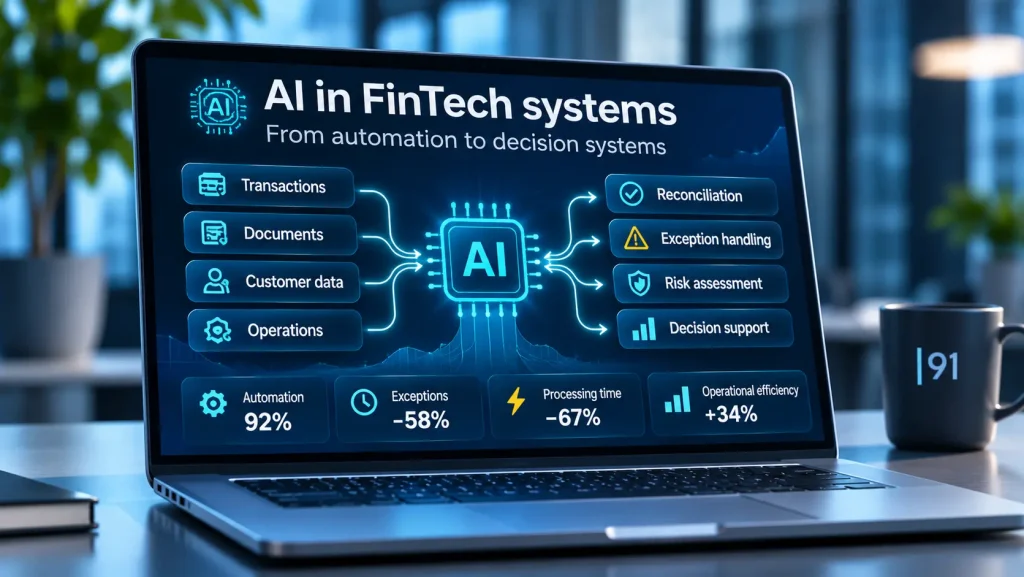
Connected financial data creates opportunities to automate more of the operation and provide better information for decisions.
That can mean automatically processing or reconciling transactions, applying decision logic to financial workflows or identifying conditions that require action.
Historical data combined with other relevant data points can also support predictions, while AI can be introduced where it provides useful capabilities beyond conventional software and rules.
The appropriate approach depends on what the financial process needs to achieve.
As financial platforms evolve, new product capabilities often depend on information that is already being collected elsewhere in the system. Financial reporting, cash flow forecasting,…
A financial platform has been operating successfully for several years. Revenue is growing, customers are satisfied and the product roadmap is ambitious. Yet the engineering…
Financial technology has undergone an extraordinary transformation over the past two decades. Banking platforms, payment providers and financial software companies have developed systems capable of…
| 91 designs, develops and integrates financial software across banking, payments, data, external systems and operational workflows.
Whether the next step is a new financial platform, an integration, workflow automation or further development of an existing system, we start with how the financial operation actually works.