I believe AI is opening up some of the most interesting opportunities in software engineering we have seen in years.
Much of the attention still goes to chatbots, assistants and content generation. These applications have their place, but what interests me more is how AI changes the software we can build.
For a long time, software development has been about translating business processes into predefined rules and workflows. That approach has enabled enormous progress, but it also has limitations. Many activities still require people to interpret information, understand situations and decide what should happen next.
AI gives us the opportunity to bring some of those capabilities directly into software. And that could change how businesses operate.
A new generation of business software
Traditional software is extremely effective when the rules are clear. It processes orders, manages transactions, calculates prices and coordinates workflows with speed and consistency.
AI adds something different: the ability to work with information that does not always fit neatly into predefined structures.
Think about the amount of time businesses spend processing documents, reviewing transactions, investigating exceptions or understanding information received from customers and suppliers.
These activities often sit between otherwise automated systems. The software handles the structured parts of the process, while employees are responsible for interpreting the information in between.
With AI, we can start addressing that gap.
A financial platform could interpret incoming documents, identify missing information and prepare transactions for processing. An e-commerce system could analyse product information from different suppliers and recognise inconsistencies before products are published. An operational platform could identify unusual patterns and help teams respond before problems become more significant.
These are not entirely new business requirements. What has changed is our ability to address them through software.
From intelligence to operational value
I think the real opportunity appears when AI becomes part of an existing business process rather than a separate feature.
Imagine a company receiving hundreds of supplier documents every day. Some arrive as structured data, others as PDFs or emails, often with different formats and terminology.
Traditionally, employees may need to review these documents, extract information, compare it with existing records and decide how each case should be handled.
AI can now take on a meaningful part of that work.
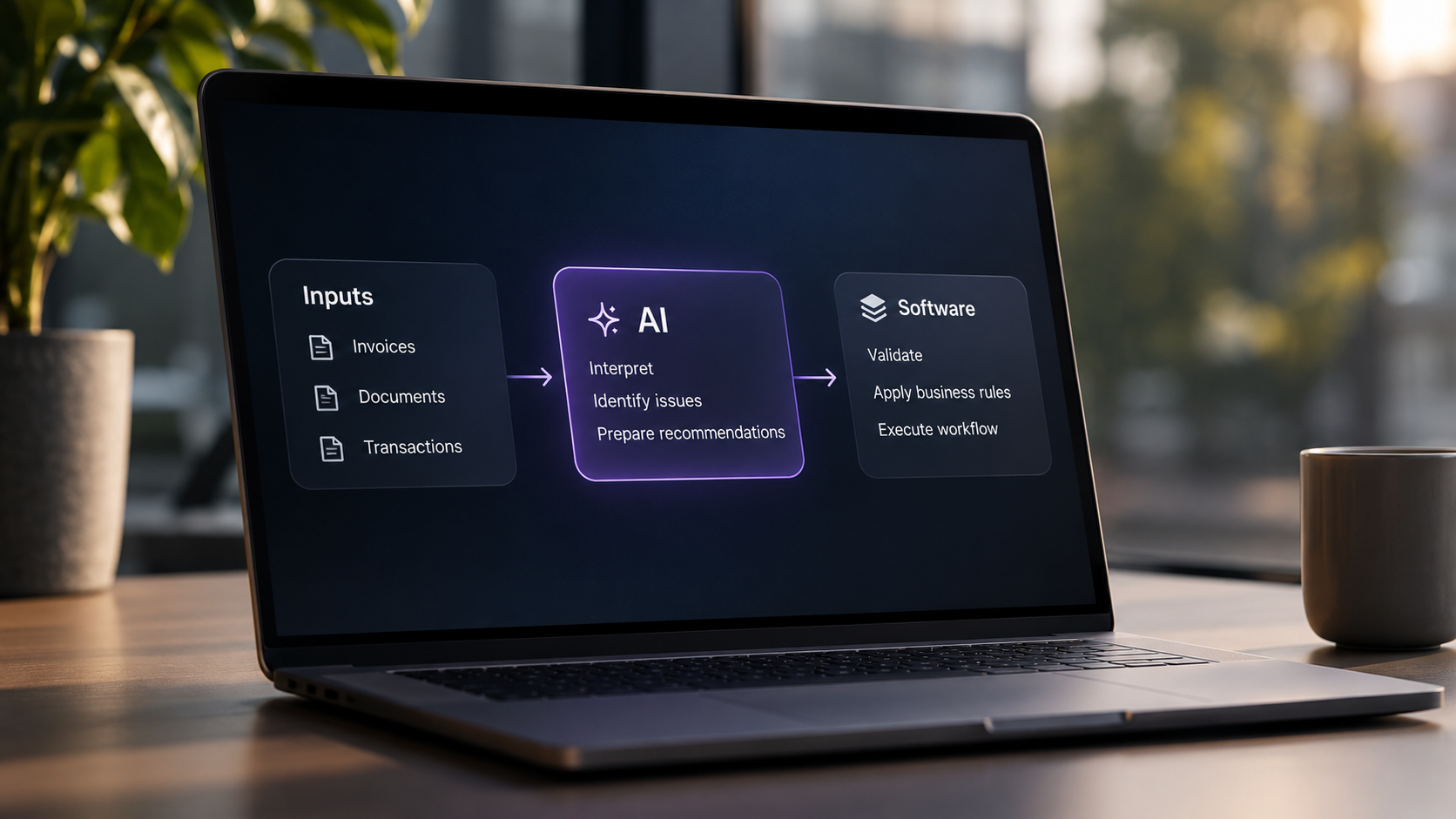
It can interpret the documents, identify relevant information and recognise potential discrepancies. The surrounding software can validate the results, update the appropriate systems and direct exceptions to employees when necessary.
The result is not simply a faster way to read documents. It is an opportunity to redesign the entire workflow.
People can spend less time moving information between applications and more time dealing with situations that genuinely require their attention.
And once these capabilities are part of the software, they can be applied consistently across larger volumes of work.
That is where AI becomes interesting from both a business and an engineering perspective.
New possibilities for software engineering
For software engineers, AI introduces a new set of capabilities to work with.
We can combine conventional application logic with models that interpret language, recognise patterns and evaluate information in ways that previously required extensive custom development or manual intervention.
This creates opportunities to build more capable applications without attempting to describe every possible situation through fixed rules.
It also changes some of the decisions we make when designing software.
We need to determine which activities benefit from AI, how its results become part of an operational workflow and where conventional software should continue to manage execution.
An AI component might interpret a supplier invoice, for example, while the application verifies amounts, applies approval rules and records the transaction.
This is not about replacing traditional software engineering. It is about extending what we can achieve with it.
Of course, these capabilities also need to work reliably. AI can make mistakes, so validation, monitoring and clear responsibilities remain important. But these are engineering challenges we can address through good architecture and thoughtful implementation.
The interesting part is that we now have more options when deciding how to solve a business problem.
The opportunity ahead
I expect AI to become a normal part of software development, much like APIs, cloud infrastructure and automation have become over time.
Not every application will need AI, and many processes will continue to work perfectly well with conventional software. But for businesses that depend on interpreting large amounts of information or coordinating complex operations, the possibilities are significant.
At | 91, we see this as a natural evolution of the work we already do: designing software architectures, connecting business systems and developing platforms that support real operations.
What excites me is the possibility of combining those foundations with capabilities that were previously difficult to implement.
For founders, this creates opportunities to rethink processes that have remained largely manual despite years of digitalisation. For CTOs, it opens up new approaches to building applications and extending existing platforms.
I believe we are still at an early stage of understanding what this will mean for business software. And that is precisely what makes this such an interesting time to be involved in software engineering.
Daan Mallens, Founder | 91
Daan Mallens is the founder of | 91, a software engineering company with teams in Utrecht, Sydney and Pune. His work focuses on software architecture, system integration and developing platforms that support complex business operations.
With experience building and developing businesses and software platforms, Daan approaches technology from both an entrepreneurial and engineering perspective. His focus is on creating systems that remain reliable, adaptable and manageable as businesses grow.
Related reading
AI works best when the system behind it works
Why integrating AI into existing software requires more than connecting a model.
Your software works. But do your systems work together?
How system integration and API architecture support reliable business operations.
Automation vs AI: Systems need better decisions, not more intelligence
Understanding when traditional automation is sufficient and where AI adds value.