


Marketplace operations don’t fail because of demand. They fail because of structure. As sellers scale on platforms like Bol.com, complexity increases rapidly.
More orders.
More products.
More dependencies between systems.
What starts as a manageable setup becomes harder to control. This was the reality Growdt was designed to solve.
CONTEXT
Marketplace operations at scale
Marketplace selling introduces complexity that goes beyond traditional e-commerce. Each platform has its own:
Rules
Data structures
Timing
Operational constraints
At the same time, sellers operate across:
Multiple tools
Multiple workflows
Multiple systems
Without structure, operations become fragmented.
THE PROBLEM
Fragmentation as the default
Before Growdt, operations were distributed across:
Spreadsheets
Plugins
Marketplace integrations
Manual workflows
This created a system where:
Data was inconsistent
Processes required coordination
Errors increased with scale
Operations depended on manual intervention
The system worked. But it did not scale.
THE APPROACH
Designing the system, not adding tools
Growdt was not built as another tool. It was designed as a system =. The goal was not to add functionality. It was to replace fragmentation with structure. This required:
Centralising data
Defining workflows
Structuring integrations
Controlling execution
Every part of the system was designed to operate together.
WHAT WE BUILT
A structured marketplace system
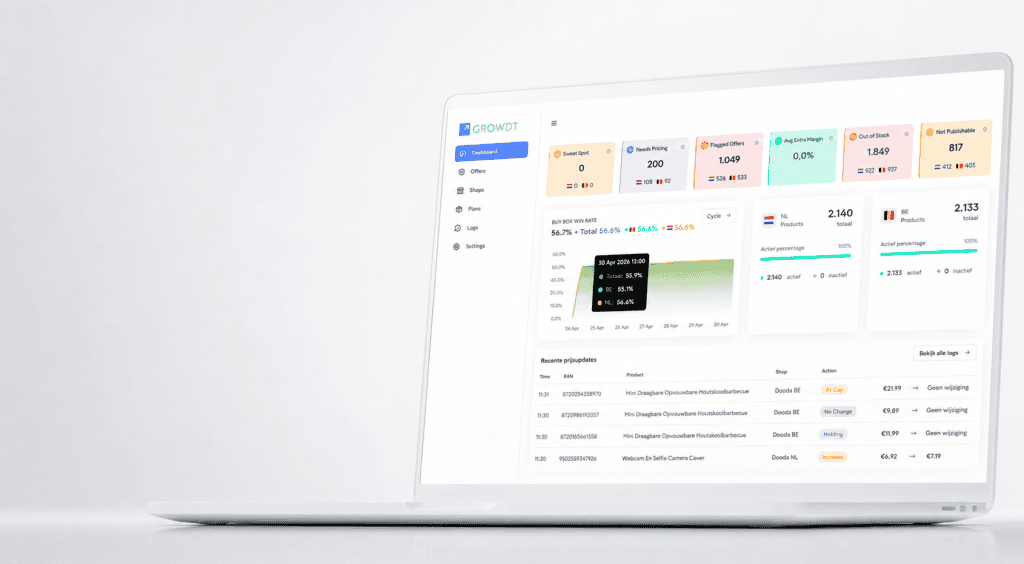
Growdt operates as a single platform for marketplace operations.
Integration layer
Deep integration with marketplaces like Bol.com.
- orders
- product data
- inventory
All flow into one structured system.
Unified data layer
Operational data is centralised:
- orders
- inventory
- pricing
This creates:
Consistency
Reliability
Real-time visibility
Automation layer
Manual workflows are replaced by:
- automated order processing
- real-time inventory updates
- pricing automation
Processes execute without coordination.
Operational control layer
One interface manages the full operation.
Not as a dashboard.
As the control layer of the system.
Scalable architecture
The system is designed as:
- multi-tenant
- API-driven
- built for increasing volume
It supports growth without requiring structural changes.
BEFORE VS AFTER
Before
- manual order handling
- disconnected systems
- inconsistent data
- operational overhead
- scaling increased complexity
After
- automated workflows
- one structured system
- consistent real-time data
- reduced manual work
- scalable operations
WHAT CHANGED
- manual processes eliminated
- data became reliable
- operations became predictable
- complexity became manageable
- growth no longer introduced fragmentation
WHAT THIS PROVES
Marketplace operations don’t require more tools. They require system design. When structure is introduced:
- integrations become reliable
- workflows become executable
- data becomes trustworthy
- operations become scalable
FINAL PERSPECTIVE
Growdt is not a feature set. It is a system. It shows what happens when marketplace operations are designed instead of assembled.
Systems don’t scale because of features.
They scale because of structure.
If you’re building or scaling marketplace operations, let’s have a conversation.