


Selling on marketplaces looks simple.
List products.
Process orders.
Ship and repeat.
At small scale, it is.
At scale, it becomes one of the most complex operational environments in e-commerce. Not because of selling. Because of everything that happens around it.
Marketplaces introduce structural complexity
Each marketplace operates as its own system.
Different APIs
Different rules
Different timing
Different constraints
At the same time, each seller operates differently.
Different product structures
Different pricing strategies
Different workflows
Different scale
This creates a system where:
Operations are not standardised
Behaviour is not predictable
Complexity increases with every integration
Where operations break
The complexity becomes visible in core processes.
Inventory
Stock must remain consistent across:
Multiple marketplaces
Internal systems
Logistics providers
Without structure, this leads to:
Overselling
Stock mismatches
Manual corrections
Pricing
Pricing is dynamic and competitive. It depends on:
Marketplace conditions
Competitor behaviour
Inventory levels
Without a system, pricing becomes:
Manual
Delayed
Inconsistent
Orders
Orders are distributed across systems. Each marketplace introduces:
Different formats
Different flows
Different states
Without control, order handling becomes fragmented.
Why tools don’t solve this
Most setups rely on tools.
Plugins
Marketplace connectors
Standalone repricers
External dashboards
Each tool solves a local problem. Together, they introduce:
Data duplication
Hidden dependencies
Inconsistent behaviour
The system becomes harder to operate with every addition.
Why integrations become fragile
Marketplace operations depend heavily on integrations. But most integrations are:
Point-to-point
State-dependent
Timing-sensitive
This creates systems where:
Data arrives late or incomplete
Processes depend on sequence
Failures are hard to trace
At scale, integrations don’t just connect systems. They define how the system behaves.
Marketplace complexity is a system problem
The issue is not tools.
It is not integrations.
It is structure.
Marketplace operations require:
Clear data ownership
Defined workflows
Controlled execution
Structured integrations
Without this, systems drift into:
Manual work
Operational risk
Unpredictable behaviour
What a system approach looks like
A structured marketplace system behaves differently.
Inventory is controlled centrally
Pricing logic is defined and automated
Orders flow through consistent processes
Integrations are structured, not improvised
The system operates as one.
Not as a collection of tools.
What this looks like in practice
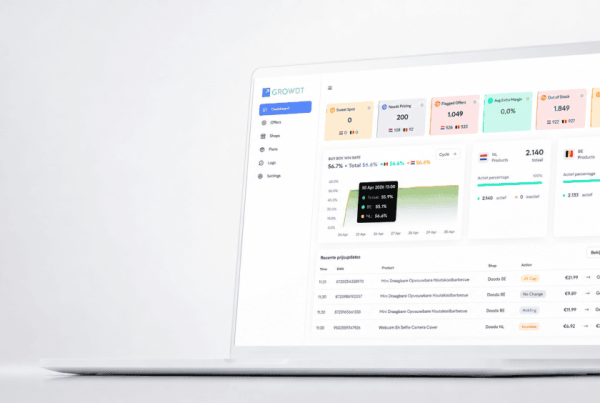
We’ve applied this approach in real-world systems. Growdt is a SaaS platform designed for sellers operating on Bol.com. It replaces fragmented tools with one system that:
- connects marketplace data
- automates operational workflows
- structures pricing and inventory logic
- maintains control across growing volume
Operations that previously required coordination are executed within one system.
Final perspective
Marketplace operations don’t break because of scale. They break because of structure. At that point, adding tools does not help. You don’t need more functionality. You need a system.
Marketplace complexity is not a tooling problem.
It is a system design problem.
If this resonates, let’s have a conversation.