AI has opened up possibilities that were difficult to imagine just a few years ago. Businesses can analyse large amounts of information, automate more complex activities and introduce capabilities that previously required substantial development work.
For founders, this creates opportunities to improve existing products or develop entirely new services. For CTOs, it introduces another technology that needs to work within an already complex software environment.
And that is where much of the work begins.
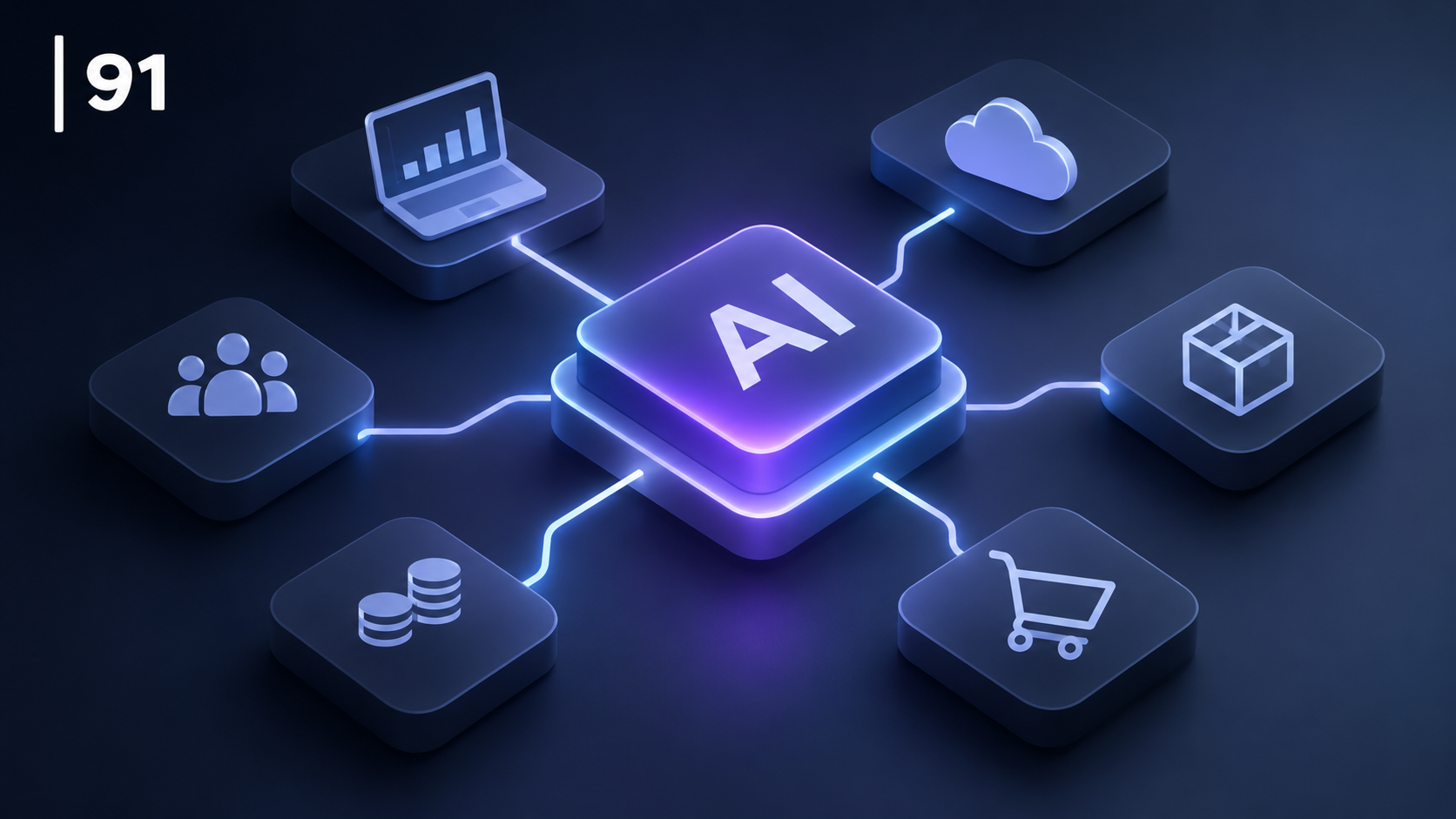
Most businesses are not starting from scratch. They already depend on financial applications, ERP systems, CRM platforms, marketplaces and software developed over many years. Some of these systems are built internally, while others are provided by external companies.
Introducing AI means working within that environment. The technology may be new, but the systems it needs to interact with usually aren’t.
Understanding what is already there
When we look at opportunities to introduce AI, I prefer to start with the existing software and the processes it supports.
What information is available? Which applications are involved? How do they communicate? Where do people still need to intervene, and which parts of the process could be improved?
For a founder, the starting point might be a relatively straightforward idea: using AI to improve customer service, automate financial administration or identify opportunities within a marketplace.
From a technical perspective, the first challenge is often finding out whether the necessary information is accessible.
A company may rely on software from an external provider that offers limited integration capabilities. There might be an API, but it doesn’t necessarily expose the information or functionality required. Other systems provide exports, webhooks or restricted access to particular operations.
You cannot assume that every application can be connected in the way you would like.
This doesn’t automatically make an idea impossible. It means understanding the available options before deciding how to build it.
Sometimes an existing integration is sufficient. In other cases, we need to introduce an additional service that collects information, connects applications or manages part of the workflow independently.
There are also situations where cooperation with the software provider is necessary. These dependencies influence the architecture, the development effort and ultimately what the solution can deliver.
Making existing systems work together
Access to information is one part of the challenge. Making that information usable across different systems is another.
Consider an e-commerce business operating across marketplaces, suppliers, inventory management and financial administration. Each application has its own data structure, processes and responsibilities.
A financial platform faces similar challenges when working with banking services, accounting applications, payment providers and internal systems.
Even when integrations are available, information may be incomplete, inconsistent or updated at different intervals. Before introducing AI, we need to understand how these systems relate to each other and which information can be trusted.
That work is not specific to artificial intelligence. It is part of designing reliable software.
Once the connections are in place, however, there are more opportunities to use AI effectively. Information from different sources can be analysed together, patterns become easier to identify and operational processes can make better use of the available data.
The quality of those connections has a direct influence on what the AI application can achieve.
From an idea to a working process
There is a difference between developing an AI feature and integrating that feature into everyday operations.
Imagine a financial platform that identifies transactions requiring additional attention. The AI component may be able to recognise unusual patterns, but the application still needs to handle the results.
Who reviews the transaction? What additional information is required? Can the system initiate the next step automatically? How is the outcome recorded?
These questions affect how the software needs to be designed.
The same applies to e-commerce, where AI might support demand forecasting, product information management or decisions involving large amounts of operational data.
Some activities can be automated through established business rules. Others benefit from AI because they involve interpretation, uncertainty or patterns that are difficult to define in advance.
I don’t see much value in introducing AI where conventional automation already does the job reliably. The choice depends on the process and what the business is trying to achieve.
Designing for the environment you have
One of the more interesting aspects of software engineering is that you rarely have complete control over the environment in which a system operates.
External providers change their APIs. Applications have technical limitations. Data is not always available in the format you need. Existing processes may have dependencies that cannot easily be removed.
These are normal conditions when developing software for established businesses.
A good architecture accounts for them. It defines how systems communicate, where business logic belongs, how information is maintained and what happens when an external service becomes unavailable.
The same considerations apply when introducing AI.
We also need to consider how the technology itself will change. AI models and providers are developing quickly, and businesses should be able to adopt new capabilities without redesigning their entire platform.
Keeping integrations, business logic and AI components sufficiently independent makes that possible.
Where I see the opportunity
I expect AI to become part of many applications we already use. Some improvements will be relatively small, while others will change how entire processes are organised.
For founders, this creates opportunities to build better products and make existing operations more efficient. For CTOs, it means finding practical ways to introduce new capabilities while maintaining the reliability of the systems the business depends on.
Both perspectives are important.
An idea needs to make commercial sense, but it also needs to be technically achievable within the available environment.
At | 91, we work on that intersection. We design and develop software systems, connect existing applications and introduce automation and intelligence where they can improve how a business operates.
The interesting question is rarely whether AI can perform a particular task. It is how that capability can be incorporated into the software and processes a business already uses.
And that is a software engineering challenge worth solving.
Daan Mallens
Founder | 91
Related reading
Intelligence and automation systems
How we integrate AI, automation and decision-making into existing business systems.
Growdt — E-commerce automation platform
How software architecture and automation support complex marketplace operations.
Blackcurrant Finance — FinTech automation platform
Building connected financial systems through integration, automation and scalable architecture.